Tuesday, November 12, 2019

We All Need Help Sometimes - 10 Lessons Learned On The Way To An Ironman

We all need help sometimes. I've had lots of help in the past.

Here's a summary:
  • I've had a few triathlon coaches in the past. I still do some of the key workouts I picked up along the way.
  • I've bought packaged online training programs.  
  • I've taken fitness classes at the gym.
  • I've trained with different masters swim groups.
  • I've worked with a personal trainer who understood my goals.
  • I've studied sports nutrition to be more informed about the true science of nutrition.
  • I've taken triathlon coaching courses.  
  • I've engaged in self-study beyond training courses.  Investing time, effort and sometimes a few dollars in your own education will never be a waste of any of those resources.  
  • I've fretted over potential race results until my husband told me no one cares how I do in any race.  It was a revelation that took a ton of stress away. 

Does it make me sound flakey that I haven't stuck with coaches, classes or a trainer forever?  I don't think so. My goals changed and my needs changed as I transitioned from one phase to another. There was a time where I was a pretty competitive triathlete (insert spit take here from anyone who trained or raced with me back then who remembers the focused, bitchy competitor that I was).  Life got busy, time for training became shorter and, to some extent, my body needed a bit of a break, physically, mentally and emotionally.  Quite honestly, I'm ready to get back to it physically but I'm not sure my head is in the same space and that's OK.


The point I'm trying to make is that we shouldn't be hesitant or afraid to change what we're doing when our goals change.

  • Maybe the challenge is to recognize when it's time to move on and try it another way.  
  • Maybe something pivotal happens that brings about that awareness.  

There are lots of maybes but the point is that sometimes it's time to move on.

Where do you go?   That's your question to answer.  But moving on doesn't mean abandoning the principles that worked in the past. Takeaway lessons from good training experiences will serve you well in ways you might not anticipate.

  1. Identify your core workouts, the ones that work, and stick with them. You can vary them up a bit, but they aren't fancy, they aren't a magic bullet and they aren't easy.  They just get the job done.  I still do some of the key workouts prescribed by a few of my former triathlon coaches. (Truthfully, most of the 'keepers' are from one coach - TLM, you know who you are!)
  2.  Hit the gym.  If you think you don't have time, make the time.  Gym work is important.  I sorted out a few workouts to do in the gym in order to support the demands of triathlon training.  
  3. I learned I can do it on my own but it's more fun to have company along the way. Friends and coaches provide support, accountability and sometimes a few laughs.
  4. I learned that not all coaches deliver the right messages the right way for my needs. 
  5. Likewise, I'm not the right coach for everyone.
  6. You have to have faith in your coach to guide you along the way but you also have to be aware enough to know when it's not working.
  7. Regardless of how you train, alone or in a group, who you train with, one of the best mantras is still to just get the job done.   For me, the hardest thing is to get started. I will finish once the first step has been taken.  
  8. Treat every workout like it's the most important one you have to do. 
  9. Train with purpose every session.  
  10. You have to fuel your body well and properly but there's nothing wrong with a little chocolate therapy along the way.
How can I help you?  I have some experience and some skills that I've picked up over the years that you might be able to benefit from.  If you have a question you want me to try to answer, just ask!!

Saturday, November 9, 2019

Indoor Ride Essentials - Set Up To Ride In Just 4 Steps

1.  Your Bike


Get it ready.  Seems pretty obvious but it might require a bit of consideration.

Trainer Tire:

 If you have a wheel on trainer, consider whethere you need to swap your rear tire for a trainer tire. There was a time when trainer tires were notably less expensive than a lot of every day road worthy tires but that it no longer a hard and fast rule. Still, it's still a good idea to make the switch. Trainer tires are made from softer rubber that will get better adherence to the resistance roller on your mag or fluid trainer.   Sure, you can skip this step and ride your regular tires but be prepared to replace that tire before you hit the open road again in the spring.


Trainer tires are usually a colour other than black so it's easy to tell which is which.  Don't ride this tire outside!!

Clean it

If your weather was anything like ours, you might have been caught in some rain or mist sometime during the last few months of riding.  Clean it all off for a few reasons. For one, why bring extra dirt into the house?  But, more importantly, get the grit off your chain to prevent unnecessary wear and tear.

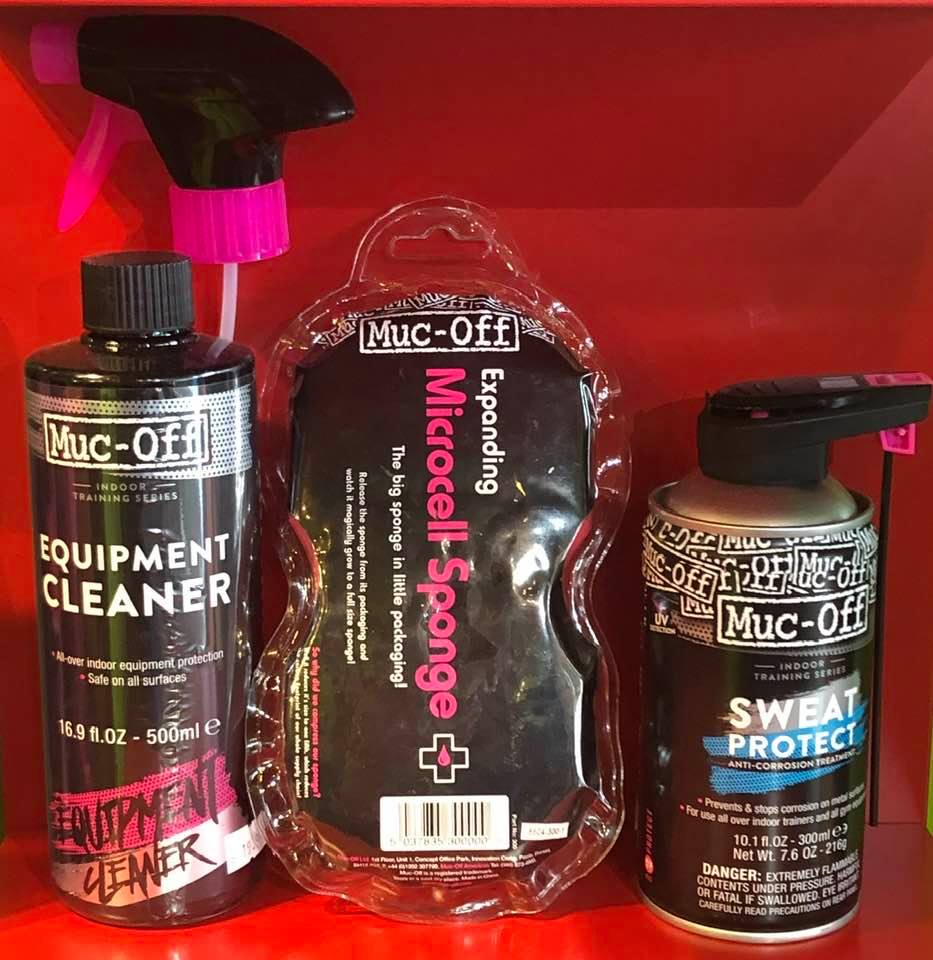
MucOff has a few products you can use to clean your bike and protect if from sweat accumulation.

WD40 has bike wash in an easy to use spray bottle.   All you need to add is a soft, lint-free cloth.

These wipe cloths are so easy to use.  Just keep a few handy in your training space and use it after a ride.

Treat it 

We use an anti-corrosion treatment like Muc-Off Sweat Protect on the frame, bars, even your trainer.  It will help repel sweat, spit and drink mix from your bike. And pay attention to the bike over the training season.  If you notice spots accumulating on your bike and it's no longer wiping down cleanly, it's time for another cleaning and protection coating.  (Pictured above).


2. Your Trainer

You'll need to decide what kind of trainer will best suit your needs so that might be the first thing you need to do.  But if you already have a trainer, it's time to dig it out and dust it off.   Like your bike, it could probably use a good cleaning and a quick application of Sweat Protect (or similar product). If you are investing in a new Smart interactive trainer, check out our Septemer 2019 article at to sort out which trainer is best for your needs You can find it here.   And you can any of buy our 4 best valued trainers here.


3. Set Up Your Training Protocol

How are you training this year? Make a plan, set some goals and put into place the metrics you need in order to meet your goals.  Here are some good options (use as many as you want):

  • - Zwift (I'm on it - look for me and we can ride together!)
  • - TrainerRoad
  • - Sufferfest (the name scares me but in a good way)
  • - Rouvy (real road videos that you can ride with your virtual bike)
  • - BKool (features real roads and video feed, similar to Rouvy)
  • - proprierary software from companies like Elite and Tacx 

Most of these training platforms are available as a monthly subscription but some new trainer purchases come with some kinds of subscriptions for free for a month or more.  If you find the right training platform for your goals and preferences, the right training platform can really elevate your indoor training experience. I know it's worked for me. I love the level of engagement and the challenges.

Zwift app is loading and getting ready for my workout.

Ready to ride!

If you want your own custom Zwift wall decal for your training space, just ask and we'll make one for you!


4.  Your Training Space (the 'Pain Cave')


The easier it is to get your training started every session, the more likely you are to get it done.  Having a dedicated space in your house, a friend's house or a other designated location will give you the commitment to get started.  I know that once I start a workout, I'll finish it. As with any workout, the biggest challenge is often to just get started.  So, set up a training space that makes it as easy as possible to get started.  Our next article will talk about setting up your training space to make it work.


Thursday, November 7, 2019

10 Tips For Staying Motivated On The Trainer

Living in a winter city, we've always spent a solid 6 months of our ride year training indoors on trainers.  Out of necessity, we've figured out how to make it work and make the best use of our indoor trainer time.  Now, smart and interactive trainers together with engaging platforms like Zwift, TrainerRoad and Rouvy have brought huge numbers of cyclists worldwide to our world.  This is one area where we have experience to share with the leagues of cyclists now spending so many hours training indoors and online.  We know that some days it's harder than others to get started and to keep going.  We know how hard it is to keep riding the road to nowhere.  We can help you stay on top of your online rides:  here are our top ten list of ways to get motivated for indoor riding and get stronger.  Here goes!

1.  Make a plan

Don't just sit on the trainer and start riding. Give some thought to the purpose of the ride and then make a plan for a workout that meets those goals. I write out my workout on an Excel spreadsheet and print it out. It will have a description of the workout as well as target zones for each interval. Once I've started a workout, I finish it.

This is a typical workout spreadsheet for those I don't already have set up in Zwift.  I have a few binders full of these!!  If you want to 'borrow' them, just ask!


2. Make a workout date

Meet up with a friend at a set time and date.  You don't want to let them down so you will show up and you will do the work.

3. Ride to the beat. You might need headphones for this one!

Music works for most people. Choose music that gets you going and is a good fit for your workout. And I realize that everyone has different taste in music so headphones are a good idea for this one. Not everyone loves to hear my playlist. 

4.  Try a movie workout

If you find the right movie, you can make up a pretty interesting workout. I'm not a fan of musicals generally but I did take part in one movie workout where the plan was to pick up the intensity every time a song came up. Maybe that's why I'm not a fan of musicals.  With a dumb comedy, set up a rule for what you need to do when something predictable happens.  With Zoolander, try doing a 1 minute pick up every time someone says "Derek".  And add a 2-minute hill climb every time someone says "really really ridiculously good looking".  And "orange mocha frappuccino" has to be worth something, right?  Find your goal movie and make a plan.

5. Make sure your bike and trainer are ready to go.

Make it as easy as possible to get your workout started and as positive an experience as possible. Set up your "pain cave" with your bike ready to go together with all the accessories you need to get going. I have a small fan, a TV, laptop stand a Netflix subscription all ready to go. Preworkout, I prepare my water bottles and some nutrition and I'm ready to ride.


We even made our own custom wall decal for our Zwift workstation.


6. Have a feedback mechanism

Use a heart rate monitor, power meter or Smart interactive trainer, anything that will give you objective, measurable feedback on your workout.  This will keep you on task and help you achieve the results for your training session and for your winter training season.

Training apps provide enough data to keep you engaged and enough rewards to keep you motivated.

7.  Use an app


There are so many online training options out there that can help you connect with other riders.  I'm on Zwift but Rouvy, TrainerRoad and Sufferfest all have their fans.  Online training apps can connect you with other riders and can have in-game rewards that help keep you going. I know that when I'm just a 5 or 10k away from making it to the next level or earning a new jersey on Zwift, I won't stop this ride until I get there.
I'm on Zwift - we can meet up!!

8.  Sign up for something

Zwift and other apps have events.  If I sign up for the event in advance, I'll do it.  Maybe I'll see you there!

9. Aerobars

I don't use aerobars on my road bike when I ride outside but for indoor riding, it sure is great to have another hand position.  Riding outside is more dynamic - you'll be moving around on the saddle and your bars frequently whether you are actively aware of it or not. Inside, you don't have to concern yourself with vehicles, traffic signals or corners so you tend to just sit more stationery.  Aerobars can get you an alternative position for some of those longer intervals.

10.  Set up a social media challenge for yourself.

I saw this one on a Youtube video.  The guy had a 4-hour trainer ride to do so he posted a survey on Instagram at the beginning of his ride asking his friends how many thought he could sit on the trainer for the whole 4 hours.  About 2/3 of the responses thought he could do it and the remaining 1/3 said "no".  He did the same thing I would have done: you finish it!  You don't want to disappoint anyone who is behind you and you want to prove the rest of them that they are wrong.  Get it done!!

Tuesday, November 5, 2019

Is There An Off Season? What Are The Seasons In Triathlon? - Part 1

Can you imagine an entire weekend free to explore the local farmer's markets, catch up with friends over coffee or dinner and still have time to get some errands done around the house?  Or imagine watching a movie when you're not doing a bike trainer workout.  Maybe those are the things people do in this elusive thing they call the "off season".  That term reminded me of an old, tried and true training mantra from our early Ironman training days *:  "When in doubt, leave it out".  I have no idea what someone else means by "off season" so I just skip using that term in favour of terms that are more meaningful to me.  I think there is real value in a complete break from structured and specific training, both in terms of the allowance for physical recovery and for the mental break. But, like any other aspect of training, every "season" has a specific purpose. 

Spring - Summer - Fall - Winter - But What Are The Seasons For The Athlete In Us?


Race Season

Race season is pretty easy to identify so let's start there. This is the season we all work towards. We pin our race hopes, dreams and goals on events in the race season.  You can race just once or you can race often, with a few key thrown in the mix. Either way, this is the season where you put all your work to the test and see what you're made of and whether your hard work has paid off.

After The Race:  Recovery, FunTime, Vacation, Transition - Pick A Name, Any Name!

Some is probably what some of us refer to as "Off Season". As someone who isn't in the habit of being totally inactive, I don't use that term.  After the big races are over, it's nice to keep moving but with no real performance goal or purpose.  And, no, signing up for every local 5k event doesn't count!!  For me, it's gym and yoga, maybe some fun bike rides, maybe mountain biking. For some, it might be team sports. 

Prep Season

During the prep season, it's time to re-establish a training schedule and get back into the habit of a regular training routine.  In addition to getting back into the habit of swimming, biking and running on a regular schedule every week, the prep season is also the time to set up all the other good habits that contribute to great racing next year:
  • establish or re-establish good dietary habits.  
  • yoga or something else that helps stretch and balance 
  • Strength training in the gym to re-build or maintain functional strength for performance
  • work on improving technique.  This is the best time to work on the swim, when you won't be fatigued from all the other volume and intervals that normally take up so much energy during the more physically taxing parts of the training seasons.


Equipment 

The prep season is also the time to start reviewing your equipment set up. The bike is the big one so, if you have any plans to replace your current ride, now is the time to get started on that since it's both the biggest chunk of your budget but it's also something that is integral to your overall performance. Get it fit and get it right!


And now, while all your other equipment is still fresh in your mind, go over all the other bits and consider which ones still suit you and which ones are due to be replaced. Consider:

  • Your helmet. Aero helmet or not, can you remember the last time you replaced it?  If not, it might be time to replace it. There are no accepted guidelines yet for the expected useful life of a helmet but the helmet industry is reviewing the notion of expiry dates.  Even if you've never crashed in the helmet, degradation of the materials and the adhesives holding the bits together has occurred. You need your helmet to provide a measure of protection for your head. If you don't recall buying a helmet over the last 3 years, it's probably time to invest in a new one.  Not is the time to at least put it on your Christmas list.
  • Your shoes.  Again, if you can't remember when you last replaced them, maybe it's time to let them go.  Sure, they're likely super comfy now that they're well past broken in.  But that completely worn in upper might no longer be providing you the structure it should have in order to maximize stability and power transfer.  If there are any deep scuffs from a crash (guilty!) or loose stitching or seaming, chances are the shoe is no longer holding your foot as securely as it should.  It's time to let it go.
  • Your kit.  Sure lycra might last forever but are you the same size and shape as you were when you bought it?  Or maybe you are as much a slave to fashion in your tri kit as you are in your everyday kit.  Maybe you have a new team or club that has a cool kit.  It doesn't hurt to start the search now when you have the time. You don't have to be that guy who orders a kit online at the last minute during race season only to find out that it doesn't fit or to have it not show up on time.  You can't race naked so get it covered sooner rather than later

Part 2 - More Seasons Coming Soon


Unless you have a real late season race like IM Arizona or Western Australia, most of us are in a post-race season Transition or Prep Season.  Part 2 will go over the goals and time frames for the other seasons of our triathlon training cycle.  Stay tuned!  Meanwhile, if you have any specific questions you want to be answered, you can always ask!


* Early days|:  when we didn't really know what we were doing but we seemed to muddle through just fine somehow. Imagine that - no power meters, no Smart trainers, no Strava. How did we do it?!! 

Saturday, September 28, 2019

Bike Trainers For Indoor Training - For Fall, Winter or Any Time of Year

There are so many options to choose from.  Hopefully, this will help you sort through them to find the best one for your needs.


New Products:  Interactive Smart Trainers

Here in Alberta, we spend a lot of time on our indoor trainers and the new Smart trainers can help us make the best use or all those trainer hours.

Smart trainers are those trainers that provide numeric feedback on multiple data fields (power, cadence, speed, distance & more) to help keep you engaged & on track.  New generation Smart Trainers have built-in BlueTooth & will help you connect & engage with others online utilizing online programs such as Zwift, TrainerRoad, or BKool.


Direct Drive Smart Trainers

When our long winters send us indoors for all of our bike training for nearly half of the calendar year, riding the road to nowhere gets both physically & mentally taxing.  But when you have a Smart trainer, you have multiple virtual ride options that allow you to race & ride with other cyclists, whether they are somewhere else in the world, just down the street or in the same room with you. You can ride structured programs with your trainer & the trainer will automatically adjust resistance per the preset program. Or you can go online & ride actual courses worldwide.  Online programs Zwift, Trainer Road, Sufferfest, & BKool will become your best training partners.  
There are multiple options in the Smart trainer category, with the first generation of these trainers now in their 2nd, 3rd and 4th iterations.  The trainers at this level were introduced and still live in the premium price range.  This includes the Elite Drivo & the Tacx Neo Smart trainers.  These top-level, premium-priced trainers are extremely smooth and quiet and offer the most accurate power measurement in their lineup.  With these direct drive trainers, your bike is directly mounted to the trainer, taking the place of your rear wheel. This set up eliminates tire wear and the need for a dedicated trainer tire.  
      
Elite Drivo II - $1,699
Tacx Neo Smart $1,899

Elite Drivo II - $1699
Tacx Neo Smart - $1899


New Direct Drive Smart Trainers - Lower Price Point (My Choice for Best Value)

Elite Direto X $1,199

Tacx Flux 2 $1,199

Tacx Flux S $999


Now that Smart trainers are more established, there are now richly featured models that offer most of us all the top end power and accuracy we need, but at about 2/3 of the cost. At this lower price, you lose a little top-end power and, perhaps, get a little less accuracy in power data but, for most of us, these trainers will work just fine.  Instead of having top-end power of 2200 watts, the Tacx trainers in this list will top out at 1500 watts.  The Direto got an update for 2019-2020 that bumps its top-end power up to 2000watts and it's accuracy to +/-1.5%.  Either way, these trainers offer more than enough power for most of us.  As an age group masters female athlete, I can sometimes hit 700 watts for a second on a sprint so a trainer that can manage 1400 or 1500 watts is more than enough for most age group athlete, either cyclist or triathlete.  

As of Fall 2020, there is a second, less expensive tier in this category and we are now seeing trainers under $1000.  These trainers typically offer top-end power of 1000 to 1400 watts.  Again, these trainers will meet the needs of many age-group athletes.  Offerings in this category are the Tacx Flux S and the Elite Suito.

Elite Suito - $999
Tacx Flux 2 - $1199

"Wheel-On" Smart Trainer Options

Elite Tacx offer a more traditional wheel-on version of the above Smart trainers which will give you the control, accuracy & connectivity of the Elite Drivo, Directo & the Tacx Neo Smart and Flux ower units.  These trainers offer notable savings from their direct mount counterparts but offer many of the features of their big brothers, as well as the connectivity to Online programs. 
Elite Qubo & Rampa - $499,  , Tacx Satori & Bushido - $999, $499 

Elite Qubo Power Mag Smart B+ - $499
Tacx Satori  Smart - $499


The Basics:  Mag Trainers - Elite Novo Force, Tacx Blue Motion

Mag trainers are the most affordable trainers in the market and they can definitely get the job done without a lot of bells & whistles.  These stand alone trainers are wheel-on mount trainers with magnetic resistance units that offer variable resistance at the click of a switch to provide most of us with enough resistance for a workout that will keep you in shape over the winter season.  These are basic but tried and truly valuable trainer.  This was the standard trainer and one of the few options generally and widely available up until the last 10 or so years.  There's no doubt they will do the job and they may still be the trainer of choice for someone who wants something portable, inexpensive but can still help you get in a solid workout.

Saturday, June 15, 2019

Key Workouts For Triathlon Success: 5 Lessons Learned From 20 Years Of Ironman Training

I'll be honest:  my last Ironman was 4 years ago and it was a DNF and my next Ironman is still 2 years out.  Armed with that information, you might choose to stop right here.  But, I have had some success at Ironman and I have learned from a few mistakes along the way.  What follows here are some of those lessons learned as well as some of those key workout sessions that, I think, ended up giving me the confidence I needed to pull off my best performances on the day.

Lesson 1 - You have to put in the miles.

I remember saying to someone about 15 years ago as they were starting to train for their first (and last, as it turns out) Ironman:

There are two secrets to doing Ironman:  1 - riding a lot and 2 - running a lot. 

As overly simple as it sounds, there is no short cut to putting in the time and doing the distance. Luckily, both of us are/were better than average swimmers so we weren't too concerned about extra swim training but weaker swimmers might want to add some time there.  The bottom line is that you simply do have to put in the time.

Lesson 2 - Stronger is better


With all the swimming, biking and running you have to do in order to successfully do Ironman or even half ironman distance, who has time for strength training?   I used this excuse myself for a valid reason to skip the gym. But the reality is that age and time both take their toll, resulting in loss of muscle mass.  I think we all recognize that the loss of muscle mass results in a corresponding loss of strength and power but it will also make you less resistant to injury.   Focused and purposeful strength training will help you maintain muscle strength and power over, making you a stronger athlete relative to those who haven't made it to the gym.  So, as much as some of us might not like to admit it or make time for it, some of the best workouts for triathlon success happen in the gym.  Don't skip this one!

Lesson 3 - More isn't always better. Better is better


Time is short and we are constantly balancing demands on our time.  In order to avoid wasting a precious commodity, it should go without saying that you don't want to waste your time.  As simple as it is to say "skip the garbage miles", separating the key workouts from the filler is not always easy.  We might all react differently to different workouts and we could have a different response to the same workout done under different conditions.  Two things you can do in order to try to get the most out of your training time:

  1. Seek the guidance of a coach. Not only can a coach bring their own knowledge and experience to the table for your benefit, but a coach can also be objective about your training results.
  2. Listen to your body.  You can expect to be tired after some high volume and/or high intensity training but you should also pay attention to warning signs.  Niggling little pains might be precursors to injury.  Elevated resting heart rate may be coincidental but it also might be accumulated fatigue.  No one knows you better than you do so pay attention to your own self.
This might be the toughest thing to get right in your training.   The quality-quantity balance for endurance race training will always be a tough balance as the miles and fatigue build up.  Quality can suffer so you need to pay extra attention to form in order to stay injury free.  Because every body responds differently to training stress, your main barometer will be your own body's response to it all. How your training partners deal with it all it

Lesson 4 - There is no one workout or training plan that is universally perfectly applicable.


Fitness for Ironman or any triathlon racing for that matter is not gained from just one workout but from a long series of workouts over days, weeks, months and even years.  So, there is no way that any single workout or program is the key to any result in any sport, let alone a sport like triathlon.  Triathlon brings with it three separate skill elements and a huge variety of individuals each with their own abilities, histories and issues.  There isn't a "one size fits all" or "one size fits most" formula for triathlon or triathletes.

Having said that, in my own personal and admittedly limited experience, there have often been those days where you realize something significant is happening or has happened.  Those are those days when something special has happened, either in fact or in your mind.   I recall those long rides where the wind or weather made it notably tough and successful completion just gives that extra edge of confidence.  Another time, I had a long open water swim where I got into that headspace like I do on those awesome long trail runs where I've just gotten lost in the meditative peacefulness of the work and the rhythm and the time just passes without any thought or effort.  Those workouts don't happen often and you can't plan them. You just have to do the work and hope you can appreciate them when you're in it.

Lesson 5 - I have some favourite workouts that are important in the run up to any big race.


I have this one workout I like to do when I'm preparing to actually race a half or full ironman distance race. These are my "A" events where I want to find my best performance on the day. These workouts are either critically long, hard or challenging.  My key workouts might be different than yours but I'll share a few with you and you can give them a try:

1. The long brick run.  

This is a long run broken up with an hour ride in the middle.  For a full ironman, distance training, I'll do about a 90 to 120-minute run, a 60-minute ride and then finish up with another 45 to 60-minute run. The idea is to have that last hour run mimic race feel as much as possible.  I'm running on legs that have been working for over 3 hours. Plus, that hour ride gives me a chance to fuel and hydrate:   during the race, there are aid stations about every mile on the run so you can stay fueled. Rarely during a long run do I fuel that much. So, this workout also allows me to properly fuel my body for that run to the finish.  It's a long, tough day but one that also gives me a lot of confidence.

2.  An over-distance swim.  

Even up to an Ironman distance race, I will do at least one long, over distance swim, not a lot over-distance, just a little. I'll definitely do one or two 4000m open water swim sessions before a full iron-distance race.

3.   An epic ride.  

This is my favourite.  An epic ride can be a big, destination ride or it can just be an accidentally really tough day in the saddle.  You should absolutely try to schedule in an epic destination ride if you can but we don't all have the luxury of time or opportunity.  With  Zwift and other similar online training platforms, it's all a little more accessible than ever so you really have no excuse. As for an extra tough day in the saddle, I'll never specifically plan an extra tough ride on any given day.  However, for most of the races where I've had my best results, there was at least one ride in the build-up to that race that ended up being just that bit harder.  It could be unknown road construction resulting in a detour, adding some extra distance. In our area, it's usually a stupid windy day that mimics just about anything you could find in Kona.  Those days - you'll come across them eventually and accidentally.  You can't plan them but you can try to be aware of them and deal with day's challenges as they roll out. Just like race day, you need to deal with issues as they arise.


So, there you have it - there is no one magic formula, no perfect plan. When you saw the word "ironman" and decided to take up the challenge, you certainly didn't think it was easy and you chose it for that very reason, right?  You got this!


Tuesday, June 11, 2019

Busting The Myth That "These Are The Best Goggles Ever - You Should Get Them"


Every few days someone somewhere on social media, is asking for recommendations on goggles that literally do not suck.  The responses are inevitably “These are the best because they work for me.”   What works for one person might not work for another so my response is the same:  recommendations from anyone who’s not your identical twin are just as likely to be useless as throwing darts blindfolded:  you might hit on something or you might not.  The only way to tell if goggles are the right fit for you is to try them on.

I sell goggles every day.  Most times, I can find the right goggle for you by just looking at you. I joke that it’s a gift but one that will never make me rich.   But, as long as I can help you find goggles that fit, I’m happy to help.   Since I can’t get to everyone, I’m going to try to walk you through your own perfect goggle fit.   Let’s get started!

 Go Strapless

When you are swimming, the straps only need to be tight enough to gently hold the goggles in place while you are moving through the water.  Test the size and shape of the goggle by trying them strapless, first.  Without using the straps, place the goggles in what feels like a comfortable spot over your eye sockets and apply gentle pressure. If they stick for just a second or longer, that’s a good first sign that they’re a match for the size and shape of your eyes. 

Keep Pushing On

Next, hold the goggles in place a little longer.  Now, you are testing to see if they are a comfortable fit for your eye sockets.  Try to sense any obvious pressure points or uneven pressure.  Anything you sense now will only be magnified the longer you wear them.   Simple enough, right?

Open Water Goggles

Triathletes sometimes say they are looking for open water goggles because, of course, they’ll be swimming in the wild.  Don’t worry about that. Go for best fit over any specific goggle category.  What is an “Open Water Goggle” anyway?  If there really were such a thing, how do we explain decades of open water swimming before this category existed?  Yes, there definitely are some features that could be useful in an open water goggle:
1.       Polarized lenses.  Polarization will help reduce glare off the surface of the water, making sighting a whole lot easier.  If anyone out there remembers the old days of one of the original Penticton Ironman Canada swims which had athletes swimming straight into the sunrise for one leg of that swim would definitely appreciate a polarized lens.
2.       Transition lenses that adjust tint as need with brightness.   There are a few races that start in the dark and finish in the light.   A lens that adapts to light conditions would be really helpful in races like Ironman Arizona, 70.3 Los Cabos and many more.
3.       Wide field of vision.  Goggles with a wide field of vision both top to bottom and around the edges can make sighting for position and direction a lot easier.
4.       Soft gaskets.  Comfort on longer swims would be really nice.

The bottom line on this one is that you really don't need specific 'open water' goggles. Even though there are some features that might be more desirable in open water conditions, you can swim indoors or outdoors in any goggle you like. If it fits, go ahead and use it wherever and whenever you like.

Oval vs Round?

Your eye sockets are either more oval or more rounded. Goggles are likewise varied in shape. Know yourself and select goggles that are a match for your eyes.  If you look at a wall full of goggles, you’ll easily be able to rule out a bunch of them.


The green goggles at the top of the photo are more oval or almond-shaped than the white and blue ones below.

The difference in shape is even more obvious when you look at the goggles from this side.


Size Matters

Goggles, like faces, come in more than one size and, one size most certainly doesn’t fit everyone.  You know whether you have a relatively small or relatively larger face. Other things to consider in terms of sizing when fitting goggles is the distance between your eyes.  Some goggles can accommodate different widths by offering multiple sizes in nose bridge pieces. However, if you are looking at a goggle with a fixed nose bridge, make sure it fits.  There are lots of styles in this group that come in 2 sizes: usual regular and junior or women's.  Don’t pay attention to the description; choose the one that’s the right size for your face.
This is "The One" goggle from Arena.  It comes in two sizes:  regular and 'junior'.  The top, blue one is the junior version and the lower green one is 'The One', the original or regular size.

The junior size measures 4 7/8" across, measuring from the outside edges of the lens.

The regular size measures 5 3/8" across, a full half inch wider.


Anti-fog:  Does It Really Exist or Work?

Anti-fog coating on goggles is delicate and temporary; it might only last for a few weeks.  After that you will have to replenish it using spray, drops or wipes.   Some people spit in their goggles and claim that method works just as well.  It doesn’t but it will get you through the current workout. In fact, spit will just allow excess organic matter to build up on your lenses, eventually making them cloudy or dirty.  Anti-fog wipes are the best way to restore them after that. 
Another home remedy is to use a small amount of dish soap. That will work well enough, just make sure you rinse them really, really well as any leftover soap residue left on the goggle can get in your eyes and it will hurt like a bi#ch.
There are some new goggles coming out that apparently have anti-fog treatment embedded into the lens material.  We’ve sold a few pairs of these but I haven’t had a whole lot of feedback on them but we’re hopeful – this could change everything!

Here are a few anti-fog treatment options for your goggles.