Wednesday, February 20, 2019

Triathlon Training: Hit The Gym With A Totally Alternate Fun Workout

So, I do have one favourite workout, my 'Go To' session for the gym and it uses equipment that I rarely have to wait for. I like to do this one about every second week. This has a lower body focused  but every muscle in your body will work in this session.  I like to pair exercises and move between them with rest only after each pair, not between each set.  

Here are the exercises:

-  Renegade Row
-  Sled Pushes (love, love them! You can do more weight than you think.)
-  Walking Lunges
-  Box Jumps
-  Rowing
-  Core Work

And here's how I put it together:

Pair #1 - Renegade Row & Sled Pushes 

I like to do 5 or 6 sets of each with this one.  For Renegade Rows, I to 5 do 8 reps per set with a moderately heavy weight.  I usually start with 8 reps and reduce it by one for each set as 8/7/6/5/4/3/2 reps for a total of 4 to 8 sets. For proper form on Renegade Rows, there are lots of videos on Youtube.  For weight, I like to use something challenging, but start with something that allows you to hold proper form throughout the set.  

For Sled Pushes, I start my warmup with 2 X 45-lb plates for the first set. The first set is a bent arm push, leading with the shoulders at the poles and running the turf (about 30 meters).  Then I sit back into chair position and straight arms. Now, pull the sled with quick steps while remaining seated. This will use your quads and knee extension with small quick steps. This will really burn your quads but it's only for two sets.  For the rest of the sets, add weight to a load that is challenging but still manageable.  I usually add 2X45 lb plates for the rest of the workout.  For the remaining set, the first push is the same as the warmup.  On the return, I move the poles to the other side of the sled.  The return push is slower and the feet stay more firmly planted on the floor. Try keeping the heels down as long as you can and push your foot into the floor, try to feel the effort all the way up the back of your legs, into your glutes.  I'll do 4 to 6 of these for a total of up to 8 sets.

Pair #2 - Walking Lunges & Box Jumps 

For walking lunges, you can use kettle bells, dumbbells or plate so there is usually enough equipment in any gym to do this one. And if your gym doesn't have enough space for walking lunges, just to stationary ones. Or you can try stationary lunges with direction variation (front, side, back, even up on a short box).  Mix it up to give your legs some variety.   For walking lunges, my favourite variation is to hold a weight plate over my head with straight arms.   I find I really have to hold my core engaged for this one which makes it more of a challenge than the amount of the weight would suggest.  I like to walk 4 or 5 steps out and the same 4 or 5 steps back and it is a really nice challenge to maintain correct form and stability on the turn.  Form is key on this overhead version of the lunges so make sure you have a spotter for proper form or at least a mirror to check yourself.  I use a 35lb plate held overhead when I'm confident I've got the form dialed in but start with a lower weight than you think for this one. Just straight up walking lunges are great too - again, I use a lower weight than I think I can handle at first.  For me, 25lb dumbbelIs or kettlebells are enough.  Then, I go right into a set of 5 to 10 box jumps on a 24" box.  I did start with a lower box until I felt comfortable and that height might be enough even after you've mastered the move.  Now, you might not see anyone else doing these and you'll know why after a few sets.

Rowing

Yes, rowing!  I like to finish off this workout with an upper body focused high intensity little push.  And the mechanics of proper rowing works with the rear kinetic chain group of muscles like the sled pushes did but rowing brings in your upper back and arms, targeting some of the same muscle groups that are primary movers in swimming.  This set is short and simple - just 1000m to 2000m of rowing as 100m each, 100m hard. I use the Concept 2 Rower and, like the swim, technique matters on this or any rowing machine.  I recommend checking out the "Training Tall" channel on Youtube for straight forward guidance on proper rowing technique.  The "Training Tall"  channel has quite a few videos there and technique is covered in a quite a few of them. Scan the titles for some good options.  This guy, Austin, knows his stuff and explains things well and simply.  Well worth your time to check it out.


Last set:  Core & Stretch

3 or 4 sets of Dead Bug. Bird Dog or Russian Twists paired with a few yoga stretches like Downward Dog and Pigeon is how I finish off this workout.  
That's it.  Trust me - you'll have done enough! 

Disclaimer: Your results may differ!


As with any exercise routine, obviously safety is important and you should never workout on unfamiliar equipment.  Consult with a qualified expert and get the proper training in order to make your trip to the gym productive and safe.   Anything I've outlined here is intended only to provide an example of what I've found works for me and is not in any way intended to be formula or guarantee for any intended result.  Be strong and be safe!

Triathlon Training: You Should Still Make Time To Hit The Gym.

Triathlon training can be time-consuming, especially if your goals are the longer endurance events like half-ironman (70.3) and Ironman distance racing.  A ton of triathletes seem to train as if they keys to triathlon success are just doing a lot of swimming, biking and running.  Yes, you do have to put in the time in order to get the to the finish line.   But in the winter off season, a little variety in your training can be a great way to hit the mental "refresh" button.  

I like to head back into the gym and do a more strength training and a little yoga in the winter. Sure, these are things we should probably be doing all year round but when our outdoor training and racing schedule is so short, we have to ride and run when the sun shines and the weather allows.  Come fall and winter, it's time to head back to the gym and spend some quality time there.  I thought I'd share some of my favourite gym workouts with you for a few reasons:

1.  I'm often training on my own so I need movements that I can safely do without a spotter.
2.  If I find myself with 30 or 40 minutes to spare, I want to get the most out of them.
3.  I follow a few pro cyclists, triathletes, swimmers and coaches on social media and there are some pretty common weight training exercises that they all do so it's clear that the basics are a pretty good start.
4.  These are all things I do to be a stronger cyclist, runner, swimmer or triathlete.

The Basics - The Exercises That Show Up In Most Strength Training Routine for Triathlon & Cycling


-  Deadlifts
-  Squats
-  Lunges
-  Bench Press or Military Press
-  Pull Ups or Pull Downs
-  Rowing
-  Bicep Curls
-  Tricep Press

However, there are lots of barriers to entry when it comes to hitting the gym to do a quality strength workout:
1.  Form is critical on most or all of these exercises in order to both prevent injury and to maximize the benefits of strength training.  So, if you are new so strength training or to anyone of these moves, make sure you have a qualified person there to guide you through There are lots of free weight and machine variations of all of these so I find there is always something I can do when I train on my own.
2.  As for how to put it all together, there are tons of training protocols in terms of the number of sets and reps and the amount of weight you should be lifting in order to achieve a goal.  I focus more on work that helps develop strength and stability for swimming, cycling and running.  The basic list above will work, for sure.
3.  Then, just doing something is better than doing nothing so, I often put together a workout while I work, based on what equipment is available. If the gym is busy, I like the flexibility of not having to stick to a specific plan. I just sort out what's piece of equipment are free and make it work, trying to get in about 15 to 20 sets in total, that can be 6 or 7 exercises of 2 or 3 sets each.  Just make it worth your while!


Disclaimer: Your results may differ!


As with any exercise routine, obviously safety is important and you should never workout on unfamiliar equipment.  Consult with a qualified expert and get the proper training in order to make your trip to the gym productive and safe.   Anything I've outlined here is intended only to provide an example of what I've found works for me and is not in any way intended to be formula or guarantee for any intended result.  Be strong and be safe!
Friday, February 15, 2019

Buying A Bike? Here's More Stuff You Need To Know So You Can Shop With Confidence - Part 3

So, this is the last of the series of three part series and we're going to touch on the other parts that come with your bike and that factor into the overall cost of the bike.  Because of their impact on your comfort, I'm going to start with the handlebars and the saddle.  Remember in Part 2, I mentioned that your body has three main points of contact with your bike:


  1. Handlebars
  2. Saddle
  3. Pedals


Let's start at the top.

Handlebars


I don't think we've ever had a customer come in and say they were looking for something specific in a bike handlebar so I suspect it's not a topic you have given any thought. I first want to specify that I'm only referencing road bike handlebars, also known as 'dropbars'. Aerobars are a topic for a  whole other article.   There are 2 primary ways I categorize handlebars: size & shape.

Size

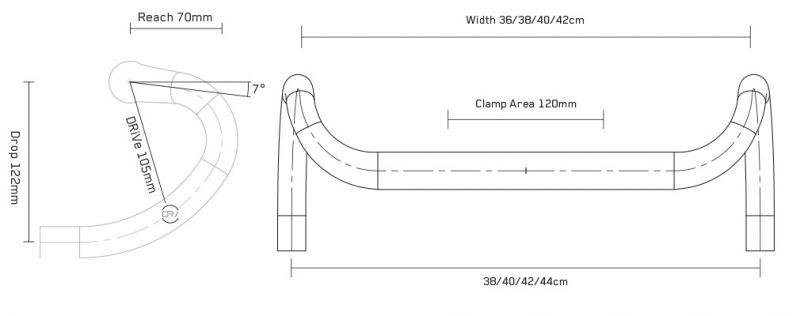
This is a pretty easy on to sort out and it's pretty easy to make sure you get the right one for your best ride comfort.  Handlebar sizes will be show in centimeters ("cm") and the measurement refers to the distance between the top edges of the bar before the bar curves down, using the middle of the bar as the measurement point.   Sizes typically range from 36 to 46cm in 2cm increments (36/38/40/42/44/46) with sizes 38 to 42 seeming to be the more common ones.  A lot of women's road bikes will have the smaller 38cm bar.  Which size is best suited to you is related to your own size, in particular your shoulder width but to some extent, you could also consider hand size.  Smaller bars will also have a tighter drop curve and a smaller reach.  So, people of smaller size and smaller hands will find smaller bars more comfortable.  Getting the correct size can also be a bit of a safety concern.  In particular, too large a bar can make it difficult to shift and brake easily and quickly.

Shape

There are a few common shapes for the curved on the drops:  standard, anatomical and compact.  There is no one shape that is best but here are a few things to consider:

  • Typically, a compact shape drop allows someone with smaller hands to have multiple possible hand positions on the bar while still comfortably reaching brakes and shifters.   
  • If you want a lower position in your drops as compared to riding with your hands on the hoods (where the brake & shift mechanism is mounted and covered), you might want the bigger drop on the anatomic shaped bar.
  • Replacement bars made from aluminum tubing are relatively inexpensive (typically under $100) so you can change your bars down the road if decide to try something different.
  • A lot of manufacturers do a pretty good job of pairing a bike with a handlebar that is a good fit for most riders of that size bike.  But we find most of or female customers are more comfortable with compact bars.
  • There are also carbon bar options and they often feature ergonomic shaping.  The price is high but once you try them, you'll never want to go back to standard round aluminum tubes.  They are pricey, though, so this is probably an investment for the future.  You can always put it on your Christmas wish list and hope for the best.


Saddle

Since this is a stand alone topic all on its own, I'll just leave you with a few thoughts:

  • Most often, if you don't get the saddle right, you'll have difficulty getting the fit dialed in and difficulty getting comfortable overall.
  • Also most often, bike manufacturers are aware that there are so many different preferences on saddle shapes, sizes and configurations out there, they can't possibly guess what will work for the customer who is buying their bike that the saddle that comes with a new bike is often just a place-holder for the one you're going to put on there.
  • There are some saddle fit systems out there but you might notice that they are usually made by a company that manufactures saddles.  So, yes, quite often they are set up to sell you one of their own saddles.  
  • Saddle fit systems often only measure one or two metrics but they can't really address soft tissue issues.  Unfortunately, the only way to address those comfort issues could involve a slightly uncomfortable discussion with the someone you barely know.  Don't worry - we've heard it all and we can help make it as easy as possible for you.  Consider that discussion to be a rite of a passage for you as a cyclist.


Pedals

Bikes are sold without pedals so you will have to buy pedals with your new bike.  There are 3 or 4 different pedals, each with their own unique cleat.  Some pedals will have a few models with features like spring tension and degrees of float being the thing that differentiates the models.  If you are buying your first bike, you might not know what your preferences are yet.  So, consider this:
  • If you've never used this style of clip in pedals (often called 'clipless' which sounds like a misstatement), you will probably be more comfortable with a pedal system that is easier to get in and out of so look for one with lower tension.  Look Keo Easy is a good example.  If the pedal system has adjustable tension, start with the lower tension setting.
  • There will be different models in a line up and they will all function pretty similarly and the cleats will be common to all or most models.  For your first bike, start with a less expensive model.  
  • There are now more generic versions of popular pedal systems like Look and Shimano pedals. The more generic pedals systems will usually be less expensive and will function exactly the same and don't let anyone tell you any different.  
  • Clipping in is easy.  Getting out is what most of us find unnerving. Practice indoors on a trainer first. It becomes second nature quickly so don't worry too, too much. Remember, we've all been there and we've all sort it out.  You got this!


Hey, I hope that helped. Now, when you go to a bike shop to look around and ask questions, you should feel comfortable and confident that you are asking the right questions that will lead to find the best bike for you.

Friday, February 1, 2019

Do You Need A Bike Tune-up During The Winter Indoor Ride Season? More Likely Than Not And Here's Why


With the proliferation of online training platforms, & our less than accommodating climate, we are seeing riders spending more time, & putting more mileage indoors on their bikes.  Indoor riding presents a few wear & tear issues that are often overlooked.  Luckily there are things that can be done to minimize or eliminate this potential damage.

Keep the Chain Clean & Lubricated

One common overlooked issue is lubricating the chain.  Not all lubes are created equal, nor do they all have a common effective lifespan.   A clean lubricated chain allows your drivetrain to work better & more efficiently, as well as can enhance the lifespan of your chain & cassette.  Regularly wipe down the chain to pull off topical dirt & excess dirty lube, and re lubricate as necessary.

Tire Pressure

If you use a wheel on trainer, regularly check your tire pressure.   A tire that is low on pressure will require excess roller tension to prevent tire slippage.  Too much tension creates binding on the tread which results in heat buildup (and ultimately a shredded tire).   Also,  remove the tension on the tire after each ride to prevent  the tire & casing from being deformed.  

Of note, trainer specific tires are designed to grip the roller more effectively without the need for additional tension on the resistance roller.   These tires are not necessarily designed to last longer, but to perform better with a wheel on trainer.  If these tires are not properly inflated they will also see accelerated wear.


Headset Corrosion Is More Common Than You'd Think

Another common issue we see on bikes ridden on trainers is headset corrosion, & bearing damage.  The headset is situated in a perfect collection spot for dripping sweat.  Covering the headset helps prevent sweat from penetrating into bearing & cups.  It is good practice to have the headset cleaned & reinstalled after indoor season.

Sweat, carbon fiber, & aluminum are the building blocks of galvanic corrosion.  A corrosion treatment on the bike, including the frame, exposed bolts (stem, aerobars, seatpost, etc) & components can prevent long term damage to your bike.

Clean Or Replace Your Bartape

Lastly, your bar tape is not a legacy item… it was not intended to be on your bike season after season.   It will become a bio hazard after a winter of indoor riding being saturated in sweat , so start planning for some new fresh tape in spring.  (Think about it - most bartape is porous and absorbs sweat which contains bacteria.  That bacteria sits accumulates and stays there ride after ride after ride.  And you are riding without gloves indoors, right?.  So, treat yourself to new bartape once in a while.)  


For the motivated rider in our climate, indoor training is a prerequisite, but with some proactive maintenance you can minimize the wear & tear on your bike.


Applying Chain Lube:  One Link At A Time


Wheel-On Trainer:  Check Tire Pressure


Cover Handlebars and BarTape When You Ride


Wednesday, January 30, 2019

Buying A Bike? Here's More Stuff You Need To Know So You Can Shop With Confidence - Part 2

Here's where I'm coming from:  I work at a triathlon and bike store and we sell road and triathlon bikes.   When I first started this gig, though, I had a pretty steep learning curve and didn't feel comfortable having a meaningful discussion with a customer looking for a new bike.  Back then, I would hand those customers off to my husband so he could offer proper assistance.  I've learned a lot and am still learning but I think I can give you a simple outline that will help you start shopping for your new bike with a little more confidence.

What Does Your Bike Cost?


In the first part of this story, I said that the cost of your bike was based on three main factors:


  1. The frame
  2. The drive train
  3. The wheels, handlebars, saddles and a few other small parts


The main focus of that first article was the frame and the importance of getting the right frame first.  Anything else that is put on the frame can be changed or updated but the frame is the one non-variable after you make the investment (unless you sell it and start over but let's try to get it right first!).

The Drive Train


First let me say that I know a super bike techno geek kind of person will be appalled at the level of oversimplification here but it's a start.  After you have your own bike, it's a great idea to take some time and learn the basics about your bike including some basic maintenance. For now, this will get you started so you can have a meaningful discussion at your local bike shop.

First off, there are a few main companies that make and sell drive trains for bikes but Shimano is a far and away the dominant player in the market so let's start there.  In the Shimano world for quality road bikes, there are 4 main levels in what I call their performance group and they are in order from least to most expensive:


  • Tiagra (10 speed)
  • 105 (11 speed)
  • Ultegra (11 speed)
  • Dura-Ace (11 speed)


Furthermore, Ultegra and Dura-Ace groups are available in both mechanical (least expensive) and electronic (more expensive).  In face, by the time you get to an Ultegra electronic (Di2) drive train, the cost will be competitive with Dura-Ace mechanical so, if you like the convenience of electronic shifting (and, trust me, you will), if you are going to that level of expense, Ultegra Di2 is as far up the food chain as I would go for my own bike.

As you move up the food chain from Tiagra to Dura-ace, other than the higher level having one more gear (11 speed vs 10 speed), most of us wouldn't be able to discern any real performance difference.   The more expensive component groups will be lighter, they will be a little prettier, but even the entry level of the Shimano performance groups, Tiagra, will serve you absolutely well.  You might notice that each of the groups will have a 4-digit number or a 5-digit alpha-numeric code attached to them.  For example, Ultegra 6800 or Ultegra 8000 (or R8000).  Those codes reference the generation (sort of like the model year) for that group.  And if you see "Di2" with the Ultegra or Dura-Ace names, that denotes the electronic versions.

The last thing we should address is the Tiagra 10 speed vs 105 which is 11 speed.  While 11 speed is pretty much the standard in new performance road and tri bikes right now, Tiagra is essentially what the same as Shimano 105, just with one less gear or cog on the rear wheel.  Don't let anyone tell you you need 11 gears.  10 speed was the standard until about 5 years ago and we all rode just fine.  Yes, more gears can give you more options but remember that even pro riders were racing the Tour de France and in Ironman Hawaii and they did just fine.  Remember that you can upgrade your drive train in the future if you like so if Tiagra 10 speed is on the frame that fits you and the bike overall fits your budget, you will ride just find with a bike outfitted with the Tiagra family.

Other Component Groups


You may occasionally come across other two components groups:  SRAM and Campagnolo.  SRAM has introduced a new electronic component group family E-Tapp and it is starting to be more common but you won't often see the SRAM mechanical drive train component groups on many bike models. If you do, look for the names Rival, Force and Red. They would line up with Shimano 105, Ulegra and Dura-Ace respectively.  Feature for feature, SRAM is a little more expensive but it does work just fine.  I'm currently riding a bike with SRAM-Red and I love it. It works just fine and I wouldn't avoid buying a bike with SRAM components. If the price and the fit are right, it's right.
And then there's Campagnolo.  Likely as not, you've heard of it but you won't often come across it on new bikes anymore. Campy (or Campi) as it's called for short, is an Italian brand and is still found on high end bike and is often favoured by fans of the Italian anything in cycling.  Campi is more generally more expensive than either Shimano or SRAM and isn't used as original equipment on many of the bike brands commonly sold in North America but you might come across it.  Just know that a bike with a Campi drive train will cost you more up front and more when you need any replacement parts.

Another thing you will very likely come across are bikes where one or more parts of the drive train are from brands other that the main brands that make entire component groups. There are some brands that are well known for making certain parts, for example cranksets or brakes.  You will often see bikes with and FSA ("Full Speed Ahead") crank or Tektro brakes.  Some might argue that these  parts will work seamlessly with the rest of your drive train. Others will say argue the opposite.  Quite honestly, if you were to ask me if I've noticed a difference between how well my bike works with a Shimano vs non-Shimano crank, I'd honestly have to tell you that a 5PSI change in my bike tire pressure would be more impactful.  I'd say that if Felt or BMC thought the part was good enough to put it on a bike, I am comfortable with their faith in the bike as a whole.

Other Parts 


Of the other parts that make up your bike, the two main other parts that will be on your bike let's talk about the handlebars and the saddle as they both warrant some attention.  Together with the wheels, just so we can give them the attention they deserve, you will find them in the next article, Part 3.  But, to highlight why I think the bars and saddle deserve attention, consider that your body will have three main points of contact with your bike:

  1. The handlebars
  2. The saddle
  3. The pedals


Your bike will not come with pedals so it is the other two, the handlebars and the saddle that will come with your bike. Because they are two of the three points of contact with your bike, they both have an big impact on your comfort on your bike so they are important and deserve full consideration.  And that article is coming to you shortly.  Meanwhile, enjoy some pictures of bike component groups.  Done correctly, some of these pictures can be works of art to some of us.


Ultegra R8000 Drivetrain 


Ultegra Rear Derailleur


Ultegra Di2(Electronic) Drivetrain


Ultegra Rim Brakes


Ultegra Disc Brakes


Wednesday, January 23, 2019

Buying A Bike? Here's What You Need To Know And How To Do It With Confidence - Part 1

The first time I bought my own real racing bike, I didn't have a clue what I was buying. I relied absolutely 100% on my boyfriend, now husband, to help. Turns out, my trust was well placed but I know not everyone will be that lucky.  Before I go in further, I'll fast forward to where I am now:  my husband and I own a triathlon/bike store and I help him with bike sales like a boss!  But, more importantly, I've observed him work with customers over the last 11 years and he is a straight shooter when it comes to helping customers get the right bike.  To him, fit is everything: if it doesn't fit you, he won't go there with you.  By fit, I mean it has to fit you in all the ways that matter:


  • It has to fit you physically.
  • It has to fit your needs.  Road vs tri bike and your training and racing goals need to be part of the bike buying discussion.
  • It has to fit your budget.
  • Some people have other requirements of their bike (colour, brand are the big ones)
  • Saddle. If the saddle doesn't work for you, you'll never get the fit dialed in. That's a whole other topic, though.  Food for thought for another day.

What Does A Bike Cost?


There are three primary cost factors in determining the price of your bike:


  1. The frame
  2. The drive train
  3. The wheels and other parts (handlebars, saddle).

Of those three things, the frame is the one thing you can't change after the fact so that is the one thing you want to get right from the outset.  Not only does the frame need to be the correct size for your body, fitness and flexibility level but it also has to fit your needs.  Any of the parts and components can be changed after the fact.  In fact, drive train components like the chain and the cassette take some wear and tear over time and should be replaced when they wear out.  Wheelsets, handlebars and saddles can be changed and upgraded but the frame is the one think you can't change after the fact. Take the time to consider your needs and options.

The Frame

Road bike vs triathlon bike is a big decision for everyone who is buying a bike with the intention of doing triathlons at some level or at some time.  Not all bikes work well as a multi-purpose bike for both road and triathlon so, hopefully, you find a bike shop that has someone like I have here - my fitter is a guy who knows both worlds really well.  And this is the critical step in buying you bike:  the frame is the one thing you can't change after the fact. Drive train and all the other parts can and often will be changed over time as drive trains, saddles and other parts wear out over time. The frame is the one thing that will be consistent.  Make sure you get this one right. Unfortunately, if you are relatively new to cycling and that buying process, you are a little at the mercy of the expertise at your local shops. And if you are new to it, you might be in a similar position I find myself in when I talk to my car mechanic: he/she could be totally making it all up and I wouldn't have a clue.  A great bike fitter and sales person should be willing and able to take the time to first educate you about bikes, your options and valuation.  Good/great bike shop staff will hopefully provide you enough information that you feel comfortable making an informed decision on your own.  If you are unsure, it might be useful to find a friend who has some cycling or triathlon background to help you through the process.  My three best tips for feeling confident enough to buy a bike:


  1. Ask your cycling friends for recommendation on a good shop to visit
  2. Ask a friend to help
  3. Do some research.


But I have some cautions too:


  1. Don't rely too much on recommendations from your friends on social media about specific bikes. While they might love their current bike, what works for them might not work for you. Plus, they might not know about options besides the one they settled on.
  2. Don't rely too much on magazine reviews, especially if the Brand X bike they say is awesome is also an advertiser.
  3. If the bike shop is dead set on selling you a bike off the floor, consider whether they are trying to make a sale or whether that is the best fit for you.


Drive Train & Other Parts - Buy A Bike - Part 2


Coming January 25.  We don't want to overwhelm anyone or leave the rest of the details to the end of a post.  The rest of the bike is just as important to understand.


Images:  Road Bike, Aero Road Bike, Tri Bike - 3 Very Different Machines


Tuesday, January 8, 2019

New Year, New You? Do You Have A Training or Diet Resolution? Make It Happen!

It's so tempting to set a New Year's Resolution but, when you think of it, New Year's is a fairly arbitrary date to choose as a starting point.  There are 364 other options.  But, in terms of organization of a training program for a summer sport, it is convenient:  with the race season 4 to 6 months out, it's about time you got started.

Training Resolutions


Our last blog article touched on this.  Yes, it's absolutely important to have goals but sometimes one big goal looming months or years in the future doesn't have enough immediacy or sense of urgency to get you to kick start your training.  Plus, there are lots of different paths and multiple steps to achieving long term goals.  To help get you going in the right direction, here's a simple strategy that should give you some stepping stones to success as well as some moral support along the way.

Step 1 

Set up a bunch of smaller shorter term goals.  Lots of little successes along the way will provide motivation as well as a sense of achievement (because, damn it - you did it!!)

Step 2

Find some people to train with.  It might not work to have just one training partner you do everything with but even if you have someone to meet up with for a weekly ride or group swim, I find it so much easier to get out the door if I know I'm supposed to meet someone in x-minutes.  Otherwise, I find it easy to put it off until later in the day when, truthfully, I usually feel better to get it done first. Training is a great way to start my day or kick off my evening.

Step 3

Just get started already!   Just do something, even if it's not an organized training plan.  If you are considering seeking coaching guidance, rather than waiting until you have it all lined up, go for a swim, a bike or a run and get your body moving.

Diet Resolutions


Just watching anything on TV or social media, you'll notice tons of weight loss and body transformation programs being advertised so it's pretty natural to take this time to think about diets or dieting.  A couple of things prompted me to think about this one.

First off, on Christmas Day, I had a discussion with my nephew and my mom about losing weight.  The discussion started with the comment that "losing weight is easy".  My mom disagreed where my nephew and I took the other position. My nephew might not be qualified to provide a definitive answer but I was arguing that it must be easy if you believe all the advertising:  every program claims to have high success rates so it must be easy, no?  I mean, advertising is never wrong is it? But, the correct answer is that my mom is right - it's not easy.  It takes discipline, awareness and constant attention.

(And if the challenge of losing weight isn't enough by itself, then there's the issue of how to pick a diet plan.  Which plan is right for you?  I can't answer that for you. I can only tell you what works for me and I am no weight loss expert. I have more experience with weight maintenance and eating well while training.  That I can share with you but something else that came across the news this week provides some support for my diet plan.)

Then, I recently saw a news piece about soon to be released update to the Canada Food Guide.  Coming in 2019, Health Canada the new Canada Food Guide undergoes a few big changes. Included the new Canada Food Guide is a focus on behavior.  So, not only is there guidance on what to eat but the suggestion is that we can be more thoughtful about the process of eating and preparing our food.  Here is my quick summary of those two changes.

Food Groups Change

It gets rid of the standard format of 4 major food groups. Instead it focuses major nutrient groups:

  • -  proteins including the inclusion of plant-based proteins.
  • -  fruits & vegetables
  • -  whole grains and carbohydrates

Behaviors Around Eating

What I was more interested, even excited to see, was that the new food guide will also address behaviors. Now, since the food guide isn't out yet, I only have my notes to go on but here are the points that struck me as being particularly helpful in helping establish more mindful eating habits:


  • Eat with people.  I think this brings with it more planning, more thoughtfulness and a meal eaten more slowly and with more joy.
  • Cook more often.  Cooking more means less processed and prepared foods, less fast food.  Cooking puts you in control of your intake.
  • Enjoy fresh foods more often.  That means fewer processed foods that are high in added sugar, salt and fat together with all the empty calories those additives bring with them.


Training & Diet Work Together To Make A Better Athlete

You can maximize the effects of your training by eating well and you will train more effectively if you have good dietary support. It's just that simple - these two go hand in hand to make you a better athlete and healthier person:

Proper diet provides:
1.  Energy support for your training
2.  Nutrients you need for rebuilding glycogen and muscles
3.  Dietary support for bone health


Cranberry Walnut & Feta Salad w/Balsamic Dressing

I took this to my family's Christmas Dinner (sorry - I don't measure stuff when I make salad. I just go by feel and by whim it so these are all approximations).

Dressing
1/4 c olive oil
2 T fig balsamic vinegar
salt (1/2 tsp??)
pepper (1/8 tsp?)
crushed garlic (1/4 tsp?)
sugar (1/2 tsp?, optional)

Salad
mixed baby greens (lots - maybe 4 to 6 cups)
1/2 c dried cranberries
2T chopped walnuts (you can toast them for more flavour)
1/3 c feta
2 or 3 T chopped onion
I like to add mandarin orange slices but not everyone likes that part so I just put it in my serving. Sometimes I add chopped avocado too.

YUM!!