Sunday, May 5, 2019

Pity Party Of One But There Is Some Hope On The Horizon

During my Pity Party of One where I was contemplating my training potential for the year, I found a grain of hope.  It came in the form of a technical article that is far above my scientific knowledge to understand but someone smarter than me outlined the key findings for me.

Just for kicks and giggles, I'm going to share the actual title of the article here:

"Skeletal Muscles Do Not Undergo Apoptosis During Either Atrophy or Programmed Cell Death-Revisiting the Myonuclear Domain Hypothesis"


If you understand that, you are way, way smarter than me. I tried to read through the article but most of it was like reading a foreign language.  The conclusion was moderately comprehensible and I had read a summary that made me happy about the message.  In a nutshell,  if you've done resistance (weight)  training previously, at any time in your past, the trained muscles responded by created more nucleii.  Now, mature muscle cells contain multiple nucleii. The results of the study suggges that when you stop training for any reason, whether it be injury, illness, lack of time, anything really, the extra nucleii that were created remain in the muscle cells.  It was previously assumed that extra cell nucleii created during resistance training died when the muscle atrophied after resistance training stopped.  However, the study suggests that these extra nucleii may, in fact, stick around.  Then, when you resume weight training after a break, there are more nucleii in your muscles that are responding to the work.  The result is a faster muscular response to the return to resistance training.


Yay!  At least there is some grain of hope, a possible silver lining to my return to training.  My plan all along was to to get back to the gym first anyway to establish a strong physical base.  I have this thought floating around in my head that I can return to moderate strength training sooner than I can return to full on  triathlon training.  Not sure if that is the case but it's the plan right now. We shall see.

Other Reasons To Hit The Gym:  Aging and Injury Prevention


Muscle and other cells die out as we age.  Specifically, after we hit 50 (and I've successfully done that), you and I will lose 1% of our muscle mass annually.  The only way to counteract this in order to maintain strength and/or muscle mass is to do resistance training specifically directed at building strength and mass.  Do the work, people, if you want to still be strong and fast!

And injury prevention is a no-brainer:  who wouldn't want that?  Our summers are short enough in Canada, we all want to take advantage of every warm, sunny day we can be active and outside.  We don't want to waste any of our summer days inside and sidelined by injury.  Strength training will help you do that.  Barring a current injury or illness, what's stopping you?  Find a gym, a training partner, a trainer, whatever you need in order to get in the gym and do the work.  Hopefully, I will see you there?

Take It Outside


Since our summers are short, it would be awesome to do some of our strength training outside.   As long as you've properly protected your skin with adequate sunscreen, it would be awesome to do some strength training outside.   I'm thinking TRX, aren't you?  I have some thoughts on that one and we'll see how it goes. If it goes well, you'll be the first to know!

I'm not likely to find as beautiful a spot to train as this to train but we still have some pretty nice spots here in Edmonton. You'll see!!

Thursday, May 2, 2019

Starting Over: From Hero To Zero And Back Again: I Will Dig Myself Out Of This Hole

I used to be a pretty damn good triathlete.  Not a great one, not a pro, but I was pretty good.  I've raced every distance from sprint to Ironman and I had a pretty good run at it for about 10 years.  If I had to describe my level of racing, it's fair to say I was an elite level age group athlete.  When I raced, I'd almost always be on the podium in a triathlon of just about any distance. More times than not, in local races I'd finish first in my age group. Even at Ironman distance, I won my age group a few times and finished on the podium a few more times.  Looking back on those best days racing is almost surreal now. I feel like I've fallen so far that the woman who raced with such passion and had that talent is a different person.  Can I find her again? Maybe she won't be quite as fast since she's 10 and 15 years older but it that fire and that talent still there?  Do I want to find it?

The Deep End - It Sucks


Shingles knocked me out.  Other than recovery from a major bike crash 20 years ago, I'd never gone through this kind of pain. I couldn't sleep or eat.  The pain was both relentless and intermittent, dull aches and sharp and stabbing.  During these first two weeks, training hasn't even been a remote thought or possibility.  I've been able to make it through the work day but I pretty much collapse when I get home. Supper and then to bed is about all I've been able to manage.  After the initial course of anti-viral medication, I was given medication for nerve pain and, now after nearly a week on that, we finally settled on a dosage that allowed me to function without being totally knocked out. At my most recent visit to the doctor, April 25, just over 2 weeks into this virus, the doctor recommended no training for another 5 to 7 days. Normally, I would be counting the days and updating the count, putting me at being able to do some training starting around May 1.  Quite honestly, though, I still feel like I've been hit by a truck but at least the truck has slowed down a bit.  I did a yoga class Monday and that was OK but it was my limit for that day.  I still have no real training mojo.  I feel like I'm really in the Deep End.

Goal Setting:  Summer Race?  Who Am I Kidding!?


I thought I'd be bold and set a goal race for myself. It would be right here in black and white and I'd have to keep myself accountable.  I was feeling better on Saturday and I thought the trajectory to recovery was an straight uphill from there.  Wrong!!  Sunday came and I felt like I'd been hit the stupid truck again. (Why can't that guy learn to drive?!!)   First things first as I'm not sure yet how soon my training mojo will return.

From Hero To Zero:  I Never Thought This Would Happen To Me


Ok so maybe "Hero" is a bit of an exaggeration but I've always tried to lead by at least providing some small examples. I admit to having gotten more than a bit lazy about my swim and run training over the past few years but I've never skimped on bike training. I coach/lead a few bike workouts a week through the winter indoor ride season. This past fall and winter, I was on Zwift.  A lot.  I had more than one person comment "you're always on Zwift". I did a few race series on Zwift and an a absolute blast working myself into the ground, literally.  I finished more than one event so spent, I couldn't even stay on my bike to do a cool down.

No, I'm not taking a nap here. This is me after one of the Zwift Fondo stages this past winter.  I actually had a lot of fun with that one.
By the end of February, I was probably in the best bike shape I'd ever been in this early in the season.  Then, March came and it was time to get ready to re-locate our business and that's when the real downward spiral to this all started.  Stress is one of the common causes of shingles and re-locating your home or your business is one surefire way to add some stress to your life. By the end of March, my half marathon training program was nothing but a memory and I hadn't been in the pool in 2 months.  By the time I finally got shingles, I'd already lost a fair amount of fitness and for some of that pitiful state, I had no one to blame but myself.  Would I have dug myself into a bigger hole had I made time to train somehow during the time we were moving, who knows?  Maybe shingles would have just hit earlier, who knows?  There are lots of maybes but one thing is for sure:  in terms of fitness and race training, I'm starting from scratch on this one. From "Hero to Zero", that's me and I'm not happy about it. (And, yes, I know the term "hero" is an exaggeration.)

Rock Bottom:   I Hope This Is It


Please let this be my rock bottom.  I'd love to pick a goal race for this summer but I'm not confident I can start training soon enough to get ready for anything I'd call "racing" this summer.  I did one short yoga class and that was my limit for now.  So a full triathlon training schedule is just a dream right now.  For now, I'd settle for healthy and ready to get going.  One morning last week, I had to choke back a few tears just getting ready for work:  everything hurt, even my skin, I hate relying on medication to get through the day.  For now, my path out of the deep end remains undefined.  If I had enough energy right now, I'd be pissed off.  Too tired for that right now and it sucks.  A lot. 


This is my bike.  It is lonely.  When will we be reunited?


Desperately Seeking Advice


I know I'm not the first and I won't be the last to have an unplanned early season break from training.  Injury and illness will happen.  If you've got any words of encouragement or your own examples, I'm all ears. I've got lots of time to read and listen so spill!  How long were you down?  How did you re-start?  How did you modify your goals?  What were your successes?  HELP!!

(FYI, I'm not really desperate.  The subtitle here is a loose reference to a moderately well-known 80's era movie starring one of the most iconic artists of  the day.  If you know the 80's, you'll know what I'm talking about.)


Tuesday, April 30, 2019

Goal Setting:

Goals:  I Will Race This Summer


Summer officially starts June 21 so I have time to get healthy and to start doing some kind of training.  I  know my training load will be pretty damn light to start with but it will have to do.  I've set my sights on just one summer race. I'd love to pin my sights on a fall race destination but my goal it health first. If and when that comes together and the budget allows, I'll specify a fall goal.  First things first as I'm not sure yet how soon my training mojo will return.

Goal Race: Edmonton Swim-Run, Sunday August 4


There are a few reasons for this one:

  1. It's new and it's something I haven't done before.
  2. My cycling is pretty good so I know it will always be there.  Swim and run training require me to set some goals and a schedule in order to get going.
  3. The run is mostly trails and that's my favourite kind of running.
  4. The swim is in the river and that's been my favourite local open water swim venue. I know it well.
  5. Swim run is traditionally done in a team of 2. You do it in tandem with another person. It takes a fine balance to manage pacing with two people with different swim and run capabilities.  The extra element to training and racing will be an interesting layer of challenge to doing a new event:  where do I find the right race partner?
  6. The race takes place in nature and the river is a dynamic environment so time goals are difficult to guess-timate. So, I won't set a time goal for anything segment or for the event overall.

Create A Path


I've picked a goal race on August 4, just over 3 months away.  I'll be starting from a lower fitness level than I'm used to so my finish goals will have to be appropriately modified.  My goal is simply to finish.  I'll set no time goals since I'm healthy and happy.  I don't yet know when the journey can start but the earliest possible start date is still a few weeks away.  Until then, my goal is to simply find the energy to go for a walk. We're out of cat food, so I'll walk to the store to pick some up.  Multi-tasking at it's best. Right now, though my path out of the deep end remains undefined.

Thursday, April 25, 2019

Sometimes Life Gives You Lemons But You Can't Make Lemonade

Wow, this has been a tough one for me.  After a really strong indoor training season and a great start on a half marathon training plan, the snow finally left and warmer temperatures returned.  Finally, it was time to go ride outside.  Yay!!  This is one of the things we look forward to all winter.  It's one of the things we picture in our minds when we ride the road to nowhere for so many indoor hours.  On top of it all, April 21 came and it was a day I'd looked forward to for months.  Together with warmer that seasonal average temperatures, it was also the day of the one concert I've looked forward to all winter. My favourite, favourite band, Metric was in town together with the awesome band July Talk and I had tickets.  So, how did April 21 work out for me?  Well, it sucked a big bushel full of lemons.  In fact, I'd been neck deep in lemons for over week and there is no definite end in sight for another few weeks.

Lemons In The Form Of Shingles

Actually, the lemon in my life started with a pain in my shoulder on Friday, April 12 and I didn't think much about it.  I get a muscle pain in that area all the time and usually a good massage will do the trick. It worsened through the weekend and migraine headaches were added to the mix for kicks and giggles.  I couldn't find any comfortable position to sit or lie down.  I just hurt all over.  The one thing that I didn't think much of that should have been a big hint was the fact that the skin on my left arm was really sensitive to touch, almost as if I had a sunburn.

By Monday, I was desperate and thought a massage might help. Luckily, I was able to get an appointment for 1PM. She was probably using moderate pressure as we had discussed but that ended up being one of the most painful massage experiences of my life and it wasn't that the massage therapist went any harder than usual. The nerve sensitivity caused by the virus made me overly sensitive to the pressure.  The massage did loosen up tight muscles so there was a bit of a silver lining there.  I did make it to yoga class that evening and that was the only mild relief I'd had in 3 days.  As it turns out, mild exercise is a good distraction from the pain.

Tuesday came and I still felt like I'd been hit by a truck.  Then, once my bleary eyes started to focus, I finally noticed the new rash on my chest and upper back.  Yup, it was shingles.  The rash didn't hurt but just about everything else did.  At least now we knew what we were dealing with and drug therapy was going to be needed.  I did get that sorted out with prescriptions for the anti-viral and Tylenol 3 for the pain so my week-long medication protocol began.  Sadly, when the drugs ran out, the pain persisted and I was quite miserable and unhappy.

The rash is actually quite minimal. It never really hurt or itched. 
And the rash on my back is even smaller - it's really just 4 blisters spread in a line across my back.


A common complication with shingles is post-herpetic neuralgia or PHN.  Basically, nerve damage caused by the shingles virus causes the damaged nerves to send random, uncontrolled pain signals to the brain which causes a burning or throbbing sensation.  So, that's where I'm at.  That is my lemonade and it sucks.  So much.

Lemonade

I am not super anxious to return to training right now, simply because I'm just in too much pain to event think about it.  With the right dose of pain medication, I can start doing a little more than getting through a day at work and going straight to bed.   The doc said nothing, absolutely nothing for at least another week and I am quite happy to oblige.  I thought I'd start by helping my husband make supper tonight.  This is what I've come to. From being an actively training triathlete to trying to make salad.

I love lemonade. But if that's all I could ever drink, I'd tire of it mighty quickly.  I know I'll get a little better every day and I know I'll slowly be able to increase my activity level but my dilemma now is going to try to be self-aware enough to know when to start and how much is enough.   I am not the first triathlete or endurance athlete to be kicked to the sidelines by shingles and I certainly won't be the last.  There is still no one proven path back to health and training but there are multiple reports of athletes who jumped in with too much too soon.  These athletes suffered from things like:

  • sub-par performances,
  • prolonged recovery time
  • recurring neuralgia pain
  • subsequent additional breaks in their training due to illness  


One medical journal report I came across explained it exactly right:

"The variety of factors that compel highly trained athletes to exercise so intensively and work through difficulties could be disadvantageous in this situation."  

In other words, that very work effort that allows us to push ourselves hard to get the most out of our training also allows to overlook some serious signals our body is sending out that it needs attention.  I don't want to be the example of what happens when you do too much too soon. I want to be healthy, fit and active 10, 20 and 30 years from now.  All of our training should at its root be about health as much as fitness and don't assume that health and fitness are the same thing.  Training in our sport should include about making positive lifestyle decisions. During training season, we rely on our physical health to back up our training.  When our health is compromised, our focus should be on doing everything we can to return to physical health.  The race you're training for will be there again next year or there will be another race. It really isn't the end of the world to sit out a race or a month of training when the payoff is a faster and better return to health. It might suck a little but it's more important to live to race well another day.
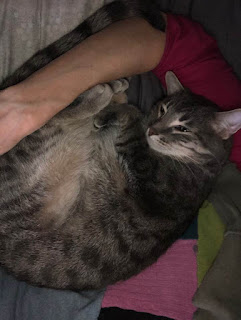
Eddie curled up under my arm during nap. He knew I was sick and was willing to offer some warmth and comfort. At least that's what I tell myself.


What I Did With My Lemonade:  Metric & July Talk Concert


I went to the concert and it was more awesome than I could even have hoped for. July Talk was likewise fantastic. I loved, loved, loved them as much as I could under the circumstances. Rather than jumping around on the floor with the masses like I would have had I been healthy and properly hydrated, I sat quietly by myself in the stands and just enjoyed the music, the distraction and people watching.  Here's something I figured out pretty quickly - the neuralgia in my hands made it too painful to clap. But I did enjoy the performances immensely and regret that I was unable to express that at the time.

My final thought of the concert is this:  for those of you looking for some new high energy tunes for your playlists, you need to check out July Talk if you haven't already.  All my friends and training partners know that Metric is already on every playlist together with Blondie and Bowie.


The Future of Lemonade?

So now, my plan just over 2 weeks in is to try to go for a walk tomorrow and every day thereafter until I can do more.  The current meds make me loopy enough that bike riding will have to be limited to indoor stuff so I'll hopefully be back on Zwift next week.  We're taking this one day at a time.  I'll be back to form someday.  I miss it.

Friday, April 12, 2019

7 Habits Of Highly Effective Athletes: What Can I Do To Get The Most Out Of My Training Time – Part 1


Sometimes, life and work gets in the way of training and none of us look forward to it, enjoy it or deal with it particularly well.  Then when you try to jump back into regularly scheduled training, it can be uncomfortable.  As I’ve now been able to get in some running again after an unplanned 2 week break, aside from being aware that it doesn’t quite feel as fluid as I want it to yet, I am finally able to find those quiet moments to be silent and just consider it all.  Here are some of the thoughts that have been bumping around in my head now that I have time to run again;


  1. Could I have managed my time away from training better and kept some level of fitness up?
  2. Am I just lazy and was I looking for an excuse to have to some time off?
  3. What can I do better to make my training as effective as possible?
  4. What are my goals with all of this?  Racing, training, health??
  5. Should I turn right or left here? 


So, yeah, my mind was all over the place.  But, when I force myself to focus on the real issues and the solvable problems, I realize that, even if I could have carved out time to get a few workouts in, unanticipated time off happens to all of us at some point.  If it’s not due to work, it could be illness, injury or family time as the cause.  (And BTW, I did decide that I’m not entirely lazy even though I definitely enjoy pretending I am sometimes.)   My ‘A-HA’ moment came when I recognized that the one thing that I can always control and improve on, that I can blame on no one else, is the effectiveness of training.  Whether I have limited time or a lot of time to train, training should always be purposeful and effective.  That let to the consideration of what effective training looks like:  what habits could I adopt that would move me in the right direction towards more purposeful, more effective training, to allow me to optimize the training value of my time. 

I turned to Google, and asked for the “7 habits”, hoping to get one quick and perfect answer.  Google found a few lists for me but no one list was quite the right fit for me.  However, there was enough food for thought to get me started.   So, here it is, my own personal list:  My 7 Habits to Better and More Successful Training.   Take a look, maybe there are a few takeaways that you can apply to your own training.  Like me, maybe you can do better.  And if we can all do 5% better within the same time constraints, that’s just free speed, hopefully.

1                Have a goal (or two).

How else can you make sure you are training with purpose, moving towards some goal, unless you actually have a goal.  I don’t feel that I have to have a race in order to have a goal.  Fitness and health should always be part of the goal and sometimes, that might be enough. I like to have an event or time in mind as goal but there have definitely seasons where my goals were more about fitness that racing.

2.            Make a plan and make sure it allows you to have a life.

          A training plan has to fit within a balanced schedule that allows time for work, family, recovery and anything else that need to be done.  As much as a great workout can help clear my mind from the stresses of the day but when trying to fit in all the workouts becomes a source of stress and impacts family or work commitments, something will fail in the long run.  Prioritize your time accordingly and reflect on whether the goals are reasonable for what’s going on everywhere else in your life right now.  If you have to adjust your training or your goals, remember there will always be another race or event at another time.    

3.            When you train, commit to the workout 100% and get it done.

Do the work and make it count.  I always opt for quality over quantity.   Having said that, not all workouts should be hard efforts – train hard when it’s appropriate and training easy when that’s the right thing to do.  In a nutshell, do the intervals that are appropriate and prescribed for the time of year and progress level in the program.  Train hard and ‘fast’ when appropriate; train long and controlled when needed.  Trust the plan and do the work.

After this bike session, I didn't have the energy to sit on my bike anymore. It was an awesome session.


4.            Develop a strong foundation and keep it strong.

Before I started triathlon, I spent most of my training time in a gym, either weight training, doing fitness classes or using cardio equipment like stair machines, spin bike and stair climbers.  While I needed to build my aerobic base to do triathlons, I remained remarkably resistant to injury.  Looking back on it, I know now that my weight training work gave me the strong base of support I needed in order to safely build mileage.  And in order to maintain strength and power and to combat the inevitable effects of aging, continued and consistent weight training remains important.  I don’t spend a lot of hours in the gym, just a few 30 to 60 minute gym sessions a week are all it takes to stay strong.  Like any of my other workouts, I try to make the best use of my time at the gym: get in, get it done and make it count.


There's nothing about dumbbells when you use them right.


But that’s not all an endurance athlete needs in order to have a strong foundation.   To me, foundation addresses two other critical factors:  technique and range of motion (flexibility).  I always, always try to focus on proper or better form in any aspects of my training. Better form and technique makes for a more efficient athlete.  As for flexibility, I try to get to my favorite yoga class every week.  I don’t make it every week but I do spend time in the evenings working out the kinks on the living room floor.  I do some stretching and some yoga poses and the cats think I’m playing with them.  I call it Cat Yoga and it’s become our thing.  Whether you have cats or dogs or neither, flexibility work will help you maintain range of motion which will help give you more distance per stroke in the swim and better efficiency, comfort and resilience on the bike and run.  


For now, I’m going to stop there.  The final 3 habits are less about training and more about supporting your training.  You’ll see what I mean when you get to “7 Habits, Part 2”.

Wednesday, March 20, 2019

Triathlon Training: Just Get Started - This Will Help!

I love how I feel when I'm training most days:


  • I love the feeling of freedom when I'm riding my bike on an open road on a gorgeous sunny day.
  • I love the fresh air and connection with nature and the when running trails through the trees or by the river, along a beach, anywhere beautiful.
  • I love the peace and quiet of swimming in cool open water on a hot, sunny day.
  • I love how I feel when it all comes together in any session. I love the feeling of energy buzzing through me those day.


But, guess what?  Some days, it doesn't all come together in the sunshine and rainbows.  Some days, it's just plain hard work.  Either the workout is one that is meant to push and challenge you which will put you in a bit into the hurt locker.  Or, you're just not firing on all cylinders that day.  Here's what our experience has taught us and here's why we still put ourselves through it:


  • Even on those tougher days, if you stick it out to the end, you'll feel better than had you not done the work. 
  • Any purposeful workout will push you towards your goal. 
  • Sometimes race day rolls around and you feel awesome and have the time of your life. But sometimes, it doesn't feel awesome - it just feels like tough slogging. Experience training on those hard days will give us the experience to fall back on: I've been here before and gotten through it, I can do it again today.
  • Sometimes, you start a workout or a race and it feels like you just don't have the energy you want.  After a while, things can turn around and you'll hit your stride and start to feel everything come together. You need to give it enough time for the turnaround. 


Here are my top 5 rules for my own training and how to get the most out of the myself for every workout and how to get the most out of the time that I am able to get


  1. Have a goal.
  2. Make a plan that will allow you to achieve your goal.
  3. Find or create a workout that will follows the plan and moves you towards your goal.
  4. Make or find the time to do the work.
  5. Your time is valuable so make the best of it:  train with purpose.


So, go out and get it done already!

Here's my last list for you for today:  if you find it hard to get out the door and get started, find a way to trick your body into moving, here are some of the tricks that I've found work for me:


  • Run home from work.  I work with my husband so, if I plan to run home from work, once he's gone and driven home, I have only one way to get there and that's by putting one foot in front of the other.
  • Make a date. Arrange to meet a friend or a group at a set time and place to do a swim, bike or run.
  • Join a group.  A Masters Swim Group, a Track Run Group, a weekly bike ride, anything that meets your needs and fits your schedule.
  • Just start:  if you're not feeling up to a 60 minute interval run, allow yourself to accept that a little something is better than nothing and commit to just 15 to 20 minutes of easy running and see how you feel after you get going and finish that first 15 to 20 minutes.
  • Hire a coach. Your coach will likely know that you'll be tired and struggling sometimes and working through that might be part of the plan. Trust the coach but listen to your body - don't risk injury.
  • Self-talk.  Sometimes, I tell myself "Suck it up, princess!"   You can find your own mantra but that one sometimes works for me. My other one is "What would Peter Reid do?" but you might need a more current athlete reference for your motivation.


Some things are easy, some are hard, just like life. One way to find out what you're capable of is to try something you haven't done before and explore your potential.


Sometimes, it's just nice to ride.

Friday, March 8, 2019

Triathlon Training: The Benefits Of Working With A Coach

Triathlon training can be tough enough to manage, just to find the time to fit it all in, without having to second guess whether you're doing it right and making the best use of your time.  Whether you are new to the sport or what level of experience or talent you have, having a coach on your side can provide more benefits than you would think.

Putting It All Together


Not only do you have three sports to deal deal with, but you also have work and family obligations. How to schedule key workouts around existing obligations in order to make the best use of your time and keep your workouts effective and efficient can be tricky, especially for athletes new to the sport or newly taking on new race challenges.  Coaches are there to provide a safe, balanced and efficient training plan that fits into your life.

Accountability


When I've used a coach for my own training, the fact that I had a coach who was working with me, looking out for me and counting on me to do the work gave me a level of commitment to the plan that I might not have had otherwise.   I love to have a list to follow and I love to check off every workout when they're done.  The coach is not only counting on me to do the work but they've also given me that great "to do" list that gives me the satisfaction of ticking off the boxes as I go through the program.  If I didn't do the session, I'd feel like I'd let someone down.

Special Circumstances


Illness, injury, work and family issues and emergencies will crop up.  It's not a matter of 'if' something will come up, it's a matter of 'when'.   Life will happen!  A coach works with you to adjust the plan to suit whatever changes your new circumstances warrant.   The coach will help you maintain confidence in the plan and in achieving your goals.

Another issue that I've worked with often as a coach are shift and other irregular work schedules.  In some industries, it's common to work long 12-hour days for a long stretches of 7 to 14 or more days with only minimal hours available to train on work days. Then, there are 7 to 14 days off.  Yes, those long stretches of time off are great opportunities to put in some long training days but the athlete still has to have good recovery between workouts or increase risks of injury and excess fatigue.  Schedules like these can be great opportunities for athletes if managed properly.


Periodization


There are different levels of periodization to consider.  Annual periodization refers to how your training progresses throughout the year, from off season, from building your endurance base to and through a race season, fine tuning skills and fitness right through the taper, taking you to race day.  Within each weekly, bi-weekly or monthly training block, periodization addresses the timing and nature of each workout from day to day, taking into account the nature of each workout, the training focus for the week and for each discipline as well as your work/life commitments. It is a lot to consider in order to get the best out of the athlete without risk of injury or over-training.

A coach manages those aspects of periodization for you, taking into account your skills and abilities, goals and progress.  And there will be bumps in the road that require updates to the plan as life throws in a few curve balls.  I read a comment on a social media group page recently where an athlete training for an Ironman distance triathlon 7 months down the road missed a workout.  The athlete was worried about missing one workout 7 months out from a race!  Yikes - I really felt for the athlete's anxiety, so unnecessary at that stage in the training.  There is no reason for something like this to cause undue stress and the coach is there to reassure the athlete that everything is still on track.  Your coach handles outlining the annual plan as well as adapting it for changes along the way.  Then, you as the athlete can do the work and work the plan with confidence.


Progression


How do to go from 5k to distance triathlon safely and soundly?  Progression addresses building endurance and strength to prepare you to race with purpose and confidence at longer distances.  In triathlon, safe progression from couch to Standard triathlon or even Ironman provides injury and overtraining risks on so many levels while you are building skill in swim, bike and run as well as endurance and strength.  An athlete doing it on their own can easily overdo it too early in the game and miss out on achieving the long-term goal due to physical or mental fatigue or injury.


Objectivity and Balance


Let's face it:  a lot of athletes will have some favourite and not so favourite things to they like to do.  Athletes well also have their own strengths and weaknesses. It's not uncommon for athletes to train their strengths better than their weaknesses or to train more in the discipline they like best.  But to be the best triathlete you can  be, you need to balance your time and effort between the swim, bike and run in the way that gives you the best overall result for your goal event.  Your coach brings a level of objectivity to your plan that you might not be able to get to, the result being a program that gives you the right balance between swim, bike and run training. Even better, you might find that proper training, encouragement and motivation from your coach can go a long way towards increasing your skill and comfort levels with every aspect of your training.  When you can put in the training and learn to love the swim, the bike, the run as well as putting it all together, the coach will have served you well.


If you would like to explore the option of working with coach Elise, please feel free to contact her here or on Facebook or other social media.  Look for Accidental Triathlete Triathlon Coaching.